Fill in all the gaps, then press to check your answers. Use the button to get a free letter if an answer is giving you trouble. You can also click on the button to get a clue. Note that you will lose points if you ask for hints or clues! Remember: contractions cannot be used in a formal style.
Background: Sweatshops
What is a "sweatshop"?
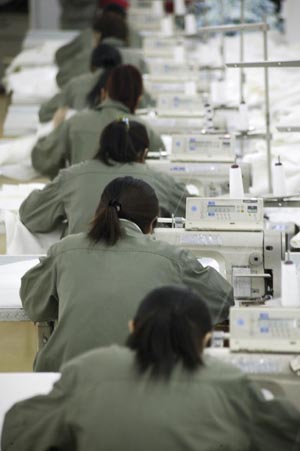
A sweatshop is a factory where health and safety regulations are ignored or -and this is common in many developing countries- simply do not exist. Workers are paid very little money, they work shifts of 12, 14, even 16 hours. Conditions are bad: Often there is not enough light, the air is bad due to lack of ventilation, and workers are not even allowed to go to the bathroom -if there is any. Most workers tend to be young females, and they are often victims of sexual harrassment and gendered violence. If they object, they are often fired. Some sweatshops -such as the fireworks factory in China that blew up some years ago, killing many people- even employ children.There have also been cases where illegal immigrants to rich countries were held as slaves and forced to work in sweatshops.
What do sweatshops produce?
Sweatshops exist in all industries where cheap labour is a competitive advantage, and especially if the machinery that is used isn't too complicated. The textile industry is the best-known example: Most cheap and many expensive clothes are made in sweatshops. Nike, for instance, is known for its extensive use of sweatshop-produced goods. The company does not own any production facilities but outsources everything but marketing and development. So, sweatshop workers in Asia's Export Production Zones sew shoes they could never afford.
Recently, Apple Computers has had its own share of the scandal: iPads and iPods are produced under conditions that, if anything, are worse than those in the textile industry.
What effects do sweatshops abroad have on the developed world?
If producing abroad is so much cheaper that it becomes an expensive luxury to produce at home, many companies will just close down their factories and outsource to sweatshops. To prevent this, wages would have to be reduced to usually unacceptable levels. The price a Western society has to pay for cheap T-shirts or cool running shoes may well be mass unemployment or income loss for many people.
What can we do?
Companies want to make money, and to do so, they have to sell something. If people know what they want, they can hit them where it hurts them most -their benefits. Some headway has been made with Nike, and some other companies have signed codes of conduct rejecting sweatshops. Still, you have to keep your eyes peeled: in order to make a boycott work, many people have to participate. Plus, you need to know what you can or can't buy.
But for a boycott or any kind of protest to work, it needs to be public: the companies you are boycotting have to be told why their products don't sell, and you will want as many people as possible to help you. In the end, it is all about communication.
The music video below deals with the sweatshop problem. Enjoy!
Have you ever wondered where Chinese toys actually come from? This is a documentary about sweatshop labour. Much less enjoyable, but with lots of information.
 to check your answers. Use the
  button to get a free letter if an answer is giving you trouble. You can also click on the
  button to get a clue. Note that you will lose points if you ask for hints or clues!
 There have also been cases where illegal immigrants to rich countries were held as slaves and forced to work in sweatshops.
 The price a Western society has to pay for cheap T-shirts or cool running shoes may well be mass unemployment or income loss for many people.