
Examples
- I’ve got a dog.
- Has she got a dog?

- We haven’t got a dog.
- I had one of these when I was a kid.
- Dave has a shower every morning.
- Danielle doesn’t have lunch at school.
- How much coffee do you have every day?
- I’ve been to England many times.
- Have you ever been to Scotland?
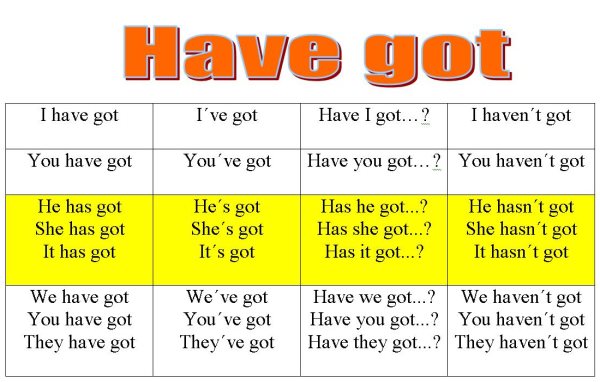
Conjugating HAVE

Expressing Possession: HAVE got
- “HAVE got” expresses possession, in the grammatical sense (if you “have got” a brother, in grammar he’s your “possession”).
- “HAVE got” is more common in British English than in American English: Americans often lose the “got” and use HAVE as a ‘normal’ verb.
- The “got” in “HAVE got”is the past participle of GET. It can never be alone, or get the -s of Third Person Singular.
- “HAVE got to” is an emphatic way to express necessity, as in “I’ve got to study harder.” More below.
- Without “got”, you cannot contract HAVE.
Exercises for HAVE got: follow this link.
BE/CAN/DO/HAVE: exercises.

Non-Possessive HAVE
- HAVE doesn’t always express possession: it can also mean “consume” and a number of other things. Non-possessive HAVE can often be translated into Spanish as tomar, or with a reflexive verb:
- HAVE lunch / a drink / coffee
- HAVE a shower / a bath / …
- You can also “HAVE an accident / an argument (with somebody)” etc.
Non-possessive HAVE works like any other, “normal” verb:
- It requires DO for questions and negations in Simple tenses:
- “Do you usually have a shower in the morning or in the evening?”
- You can’t use contractions with non-possessive HAVE:
- “I have breakfast,” NOT “
I’ve breakfast.”
- “I have breakfast,” NOT “
HAVE as an Auxiliary Verb

→ HAVE is the Auxiliary for the Perfect time forms (Present Perfect, Past Perfect …). Details are in the dedicated articles.
Examples
- I have/’ve had a shower.
- She had/’d just left the building.
- Has he done this before?
- Had they ever seen anything like it?
- You haven’t finished yet!
- We hadn’t thought of that.
Auxiliary HAVE in Complex Compound Time Forms with Modal Verbs, and combined with the Passive Voice
- In Perfect-Continuous time forms, HAVE is the “Operator” (The “A” in ‘Las preguntas se hacen ASI’): It’s the Auxiliary, and goes first:
- “Have you been crying? Your eyes are red.”
- “I hadn’t been paying attention, so the teacher’s question caught me by surprise.”
- With modal verbs, the same order is maintained, but the Operator is the modal. After a modal, HAVE is always in the infinitive, so linguists speak of “Perfective Infinitives” and the much less common “Perfective-Continuous Infinitive”. As always with the names of time forms, the name itself can help you remember the structure.
- “She might have done it, but I’m not sure.”
- “They must have been sleeping.”
- In Passive sentences, HAVE goes before BE:
- He has/’s been made redundant.
- It should have been abolished long ago.
Exercises for Present Perfect are here.
Exercises for Present Perfect Continuous are here.
Exercises for Past Perfect are here.
There’s more on http://joscha.x10host.com/Resources/
